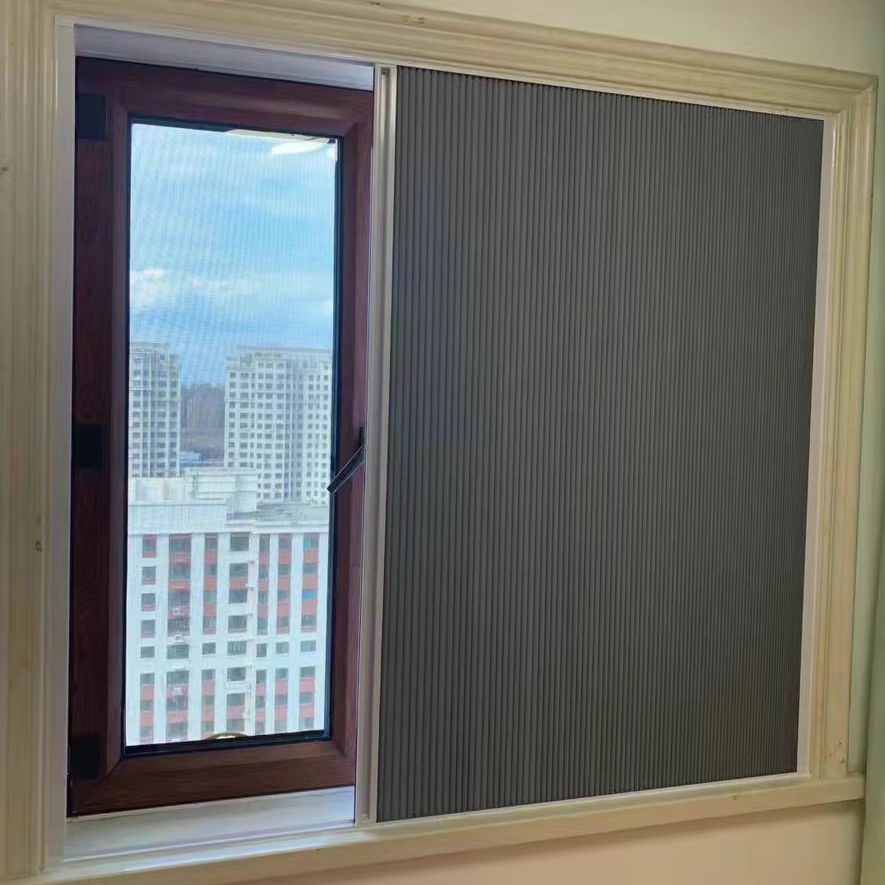
A screen for a standard window and a screen for a six-metre opening are not the same product scaled up.
At six metres, the panel area is large enough that wind load becomes the dominant force. The frame has to be rigid enough not to flex. The mesh has to be tensioned evenly across the full span. The fixing has to hold against gusts. And the system has to fold back to a compact stack, or it will be left open and stop doing its job.
This page is about what changes when the opening gets wide.
What Changes at Six Metres Wind load increases with area. A large panel catches far more wind than a small one. A screen that flexes under that load works loose at the fixings and eventually tears at the edge.
Frame rigidity matters more. A frame that’s rigid enough for a one-metre window will flex across six metres. Flexing loosens the mesh and opens edge gaps.
Mesh tension has to be even. Uneven tension across a wide span causes sagging in the middle and over-tightening at the edges. Both lead to premature failure.
The fixing has to be specified for the load. Adhesive fixing works for standard openings, but a six-metre screen exposed to wind needs screw fixing at specified intervals.
The fold mechanism has to handle the weight. More mesh, more frame and more panels mean more weight on the track, roller or hinge. The mechanism has to be specified for that.
The opening is rarely perfectly square. At six metres, a small deviation at one end becomes a visible gap at the other. Custom cutting is essential.
How a Large Screen Is Specified System choice. For wide openings, the system is usually roll-back, guardrail or multiple panels rather than a single telescopic unit. The choice depends on the opening, the exposure and whether a housing can be accommodated.
Frame. Rigid aluminium alloy, specified for the span. For very wide openings, intermediate mullions or support posts may be required to keep the frame rigid.
Mesh. 304 stainless steel, tensioned evenly across the full span. The mesh is specified for the wind load and the pet profile, not just for insect size.
Fixing. Screw fixing at intervals specified for the load. Adhesive fixing is suitable for lighter loads and rental properties, but not for a six-metre screen exposed to wind.
Configuration. A six-metre opening may be produced as two or three panels rather than one. Multiple panels are easier to handle, easier to clean and more stable in wind.
Drainage and clearance. Large openings often have a threshold or track. Confirm the screen clears the threshold and that water can drain away.
What to Check Before Ordering Measure the full opening. Width and height at the top, middle and bottom, and at both sides. Take the minimum measurement where the opening isn’t square.
Confirm the exposure. Is the opening sheltered or exposed to wind? Is it on a high floor or at ground level? Is it coastal? Each answer changes the fixing and the frame specification.
Confirm the fixing surface. Is the frame timber, aluminium, concrete or render? Screw fixing requires a suitable substrate.
Confirm the housing position. For roll-back systems, confirm where the housing will sit and whether there’s space for it.
Confirm the panel configuration. For openings wider than about three metres, multiple panels are usually recommended.
Send photographs. A photograph with a tape measure in frame lets us check the dimensions and the opening type before production.
Regional Notes Coastal and exposed locations — salt air and wind. Specify stainless steel mesh, rigid aluminium frames and screw fixing at specified intervals.
High-rise balconies — wind load increases with height. Specify guardrail systems and screw fixing. Confirm the structural suitability of the balcony before ordering.
Tropical and humid climates — stainless steel mesh is non-absorbent and doesn’t support mould growth. Specify stainless steel throughout.
Desert and dusty climates — fine sand passes through coarse mesh. Specify fine stainless steel mesh and plan for regular rinsing.
Cold climates — stainless steel mesh stays flexible in freezing temperatures. Confirm the frame specification for freeze-thaw cycles.
Why It Matters A screen that doesn’t cover the full opening, or that flexes in the wind, or that sags in the middle, isn’t doing the job it was bought for. At six metres, the difference between a correctly specified screen and a scaled-up standard one is the difference between a screen that lasts years and one that fails in the first season.
Get a Free Quote Send us the opening width and height, photographs, your country and your pets. Tell us whether the opening is exposed to wind, how high the floor is, and whether it’s coastal. We’ll recommend the right system, frame and fixing and reply within 24 hours with a detailed quotation.
WhatsApp: FSMBOR — send your size and country Email: reply within 24 hours
Message us your opening dimensions for a free quote.
Large opening mosquito screens up to six metres wide — roll-back, guardrail and multi-panel systems, rigid aluminium frames, 304 stainless steel mesh tensioned across the full span, screw fixing at specified intervals, pet-proof specification, manufactured in Foshan and shipped to over 40 countries.