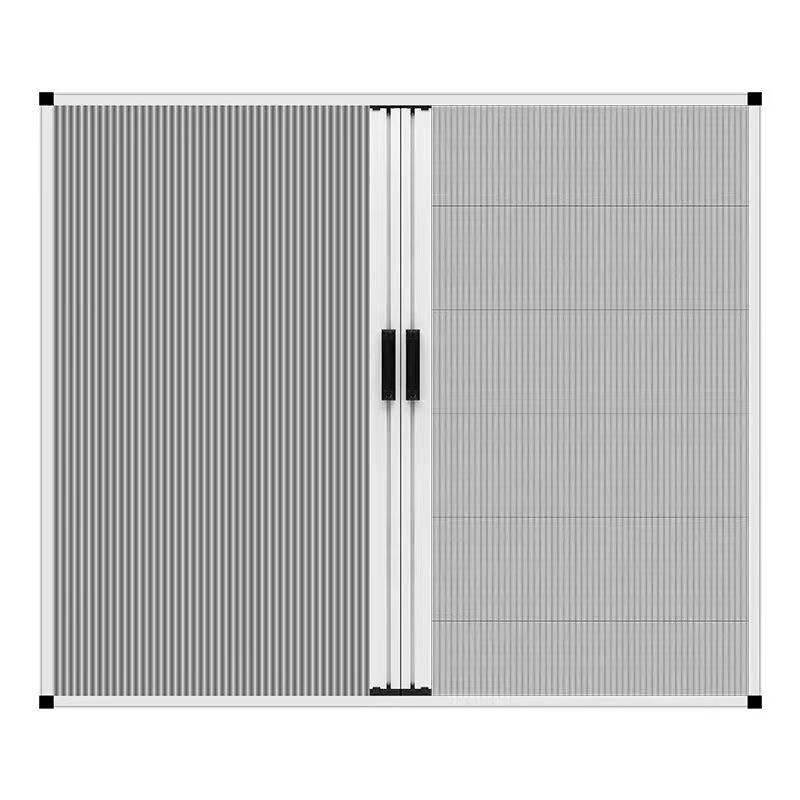
Most folding mosquito screen orders that go wrong don’t go wrong in the factory. They go wrong before the order is placed — in the measurement, the system choice, the mesh specification or the fixing assumption.
We’ve made thousands of folding screens and shipped them to more than 40 countries. These are the five mistakes we see most often, and how to avoid each one.
Mistake 1: Measuring the Door Leaf, Not the Opening This is the single most common cause of a folding screen that doesn’t fit.
What people do: They measure the door leaf, or the frame width, or the opening excluding the trim.
What they should do: Measure the full opening between the frame edges — the surface the screen will actually sit against.
For a patio door, measure the full opening width and height, including both leaves and the frame between them. For an irregular opening, measure at multiple points and take the minimum.
How to avoid it: Send a photograph of the opening with a tape measure in frame. We check every dimension against the photograph before production, and flag anything that looks inconsistent.
Mistake 2: Choosing the Wrong System for the Opening Four folding systems, four different openings. Choosing the wrong one means a screen that doesn’t cover the full opening, doesn’t fold back properly, or doesn’t survive the wind.
What people do: They choose the system based on price or appearance, without considering the opening type, the exposure or the traffic.
What they should do:
Telescopic — for openings where the width varies or a fixed housing isn’t practical
Roll-back — for wide openings with space at the side for a housing
Guardrail — for balconies, terraces and exposed openings where wind load is a factor
Double door — for the main route between inside and outside, used by pets and heavy traffic
How to avoid it: Describe the opening — width, height, exposure, floor level, traffic — and we’ll recommend the system.
Mistake 3: Choosing the Wrong Mesh A mesh that works in one climate fails in another — not because the product is poor, but because the specification doesn’t match the conditions.
What people do: They order the cheapest mesh, or the one that looks best in a photograph, without considering where the screen is going.
What they should do: Match the mesh to the climate:
Coastal and salt-air — stainless steel. Synthetic mesh corrodes and moulds.
Tropical and humid — stainless steel. Synthetic mesh stays damp and supports mould.
Desert and arid — fine stainless steel. Coarse mesh lets sand through.
Cold and snowy — stainless steel. Synthetic mesh goes brittle and cracks.
Urban and high-pollution — fine stainless steel. Soot stains synthetic mesh permanently.
Mosquito-borne disease regions — stainless steel. The mesh aperture must be small enough to block the local mosquito species.
How to avoid it: Tell us your country and city when you enquire. We match the mesh to the climate and the insect profile before quoting.
Mistake 4: Assuming Adhesive Fixing Works for Every Opening Adhesive fixing is the right choice for rentals, finished surfaces and lighter loads. It isn’t the right choice for a six-metre screen exposed to wind, or a high-rise balcony.
What people do: They specify adhesive fixing on every opening, then discover that the screen works loose in the wind.
What they should do: Specify the fixing method according to the load:
Adhesive — rentals, finished surfaces, lighter loads
Screw fixing at specified intervals — large openings, exposed elevations, high-rise balconies
Combination — adhesive on some panels, screw fixing on the main panels
How to avoid it: Tell us the floor level, the exposure and whether the property is rented. We’ll specify the fixing accordingly.
Mistake 5: Not Planning for Cleaning A screen that can’t be cleaned properly isn’t a barrier — it’s a dust trap. Once it clogs, airflow drops and the screen starts redistributing what it was meant to keep out.
What people do: They buy a fixed system that can’t be accessed for cleaning, and assume it will look after itself.
What they should do: Specify a system with accessible mesh or clip-out panels. Confirm that the panels or mesh can be reached for rinsing.
How to avoid it: Check the cleaning access before ordering. If the system can’t be cleaned easily, it will clog and stay clogged.
A Sixth Mistake Worth Mentioning: Ordering One Opening at a Time People often measure one opening, order one screen, fit it, and then realise they need screens on the balcony, the terrace and the patio — and have to start the process again.
What to do instead: Measure every opening you’re likely to want screened, in one pass. Send them together. We quote the whole order at once, produce to consistent specifications, and ship in one delivery. It’s cheaper, faster and produces a consistent result across the property.
What We Do to Catch These Mistakes Every order goes through the same checks before production:
Dimension check against photographs — we flag anything inconsistent
System recommendation — based on the opening type, exposure and traffic
Climate-matched mesh — recommended for your location and insect profile
Fixing method confirmed — adhesive, screw-fixed or a combination
Cleaning access confirmed — every system we make can be accessed for cleaning
Consistent specification across openings — one mesh, one frame finish, one fixing method
If something looks wrong at any of these stages, we raise it before production, not after.
Get a Free Quote Send us your opening dimensions, photographs and your country. Tell us whether you rent or own, how exposed the opening is, and how many openings you need. We’ll confirm the specification and reply within 24 hours with a detailed quotation.
WhatsApp: FSMBOR — send your size and country Email: reply within 24 hours
Message us your dimensions for a free quote.
Five mistakes that ruin a folding mosquito screen order — measuring the door leaf, choosing the wrong system, choosing the wrong mesh, assuming adhesive fixing works everywhere, and not planning for cleaning. Telescopic, roll-back, guardrail and double-door systems, 304 stainless steel mesh, custom sizing, manufactured in Foshan and shipped to over 40 countries.